

The courtroom was heavy with the weight of tragedy. Families of the victims sat in the pews, holding their breath, waiting for the final word on a nightmare that had spanned over a decade. The prosecutors were ready. The defense team looked grim.
And then, there was the defendant.
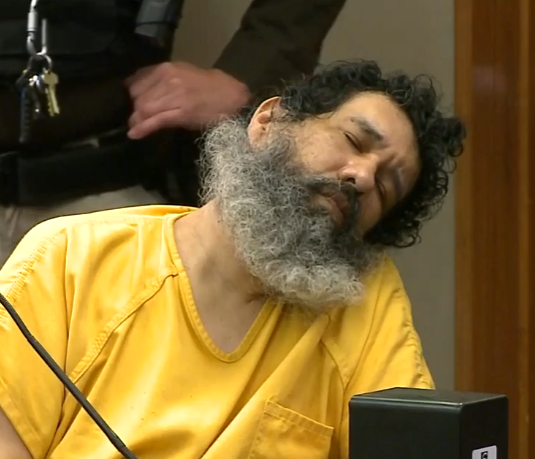
Clad in a bright yellow jumpsuit, his beard grown out into a wild, unkempt gray bush, Anthony Garcia did not look like the highly educated physician he once was. He looked like a man who had given up on reality. As the proceedings began—a hearing that would determine whether he would live or d*e by the state’s hand—Garcia did something that shocked the world.
He slumped in his wheelchair. His head rolled back. And he went to sleep.
It wasn’t just a brief nod-off. As the judges read through the horrific details of how he stalked, stbbd, and butchered four people—including an 11-year-old boy—Garcia appeared to be completely unconscious, his head lolling to the side, indifferent to the fact that his life was being extinguished by the gavel.
This is the chilling story of the “Revenge Doctor,” a man whose bruised ego led to a bl00dy rampage, and whose final act of defiance was a nap in the face of justice.
The Origin of a Monster
To understand the bizarre scene in that Nebraska courtroom, one must rewind to 2001. Anthony Garcia was a pathology resident at Creighton University in Omaha. By all accounts, he was a man who struggled with authority and competence. His colleagues found him difficult; his superiors found him dangerous.
In 2001, the department chair, Dr. Roger Brumback, and another doctor, William Hunter, made the decision to fire Garcia from the program. They cited unprofessional behavior and a lack of skill. For most people, being let go is a shameful, difficult hurdle, but one they eventually overcome. They move on, find new jobs, and rebuild.
Garcia was not most people.
He did not move on. He obsessed. He stewed in a toxic brew of narcissism and rage. He felt that these two men had not just fired him, but had destroyed his life. He began to plot a revenge that was not impulsive, but cold, calculated, and patient. He was willing to wait years to make them pay.
The First Massacre: 2008
Seven years had passed since his firing. The doctors at Creighton likely rarely thought of Anthony Garcia. life had moved on.
On a quiet afternoon in March 2008, tragedy struck the historic Dundee neighborhood in Omaha. 11-year-old Thomas Hunter, the son of Dr. William Hunter (one of the men who fired Garcia), was at home. With him was the family’s beloved housekeeper, Shirley Sherman, a 57-year-old grandmother.
They were not the intended targets. They were simply in the way.
When Dr. Hunter came home, he walked into a house of horrors. Both his young son and the housekeeper had been brutally stbbd to d*ath. The violence was extreme. Knives were found left in the necks of the victims—a signature of rage and professional knowledge of anatomy.
The police were baffled. Who would want to kll a young boy and a housekeeper? Was it a robbery gone wrong? A drifter? The investigation went cold. There were no leads, no fingerprints that matched a suspect, and no apparent motive. The community was terrified, but as the years ticked by, hope for justice began to fade.
Garcia had struck, and he had vanished. He was living in Indiana, working odd medical jobs, losing them, and sinking deeper into his psychosis. But he wasn’t done.
The Second Massacre: 2013
Five years after the first murders, and twelve years after his firing, Garcia returned to Omaha. He had settled the score with Dr. Hunter (by destroying his family), and now it was Dr. Roger Brumback’s turn.
In May 2013, Roger Brumback and his wife, Mary, were found dd in their home. The scene was eerily similar to the 2008 case. Roger had been sht and stbbd; Mary had been stbbd to d*ath.
This time, however, investigators made the connection. Two separate attacks. Two sets of victims. The common denominator? Both patriarchs were leaders in the Creighton University pathology department in 2001.
Detectives pulled the old personnel files. They found the name Anthony Garcia. They found the termination letters. And when they looked into Garcia’s background, they found a man who had purchased a handgun and researched the addresses of his former bosses.
The “perfect crime” began to unravel. Police tracked Garcia to Illinois. When they arrested him for a DUI, they realized he matched the profile perfectly. His credit card records placed him in Omaha on the days of the murders. The cold case was finally thawing.
The Trial of the Century
The trial was a marathon of grief. Prosecutors laid out a case of a man possessed by a “malignant narcissism.” They argued that Garcia traveled from his home in Indiana specifically to hunt these people down. He didn’t just want to kll them; he wanted to punish them.
The details were gruesome. The state argued that the five-year gap between the mrders showed a terrifying level of premeditation. He had years to reflect on the first two kllings. He had years to feel remorse. Instead, he felt empowered.
The jury didn’t buy his defense. In October 2016, he was convicted on four counts of first-degree mrder. The only question left was his punishment.
The Sleeping Defendant
This brings us back to the video that shocked the internet. It was the sentencing phase. A panel of three judges—Judge Gary Randall, Judge Russell Bowie, and Judge Rick Schreiner—was set to deliver the verdict.
However, the proceedings took a strange turn before they even began. Judge Randall, the presiding judge, was absent. The court record states he was experiencing severe back pain from a recent medical procedure and could not continue.
Defense attorneys leaped at this. They objected furiously, arguing that sentencing a man to d*ath without the presiding judge present was highly unusual and potentially a violation of his rights.
“It is obviously highly unusual for a defendant to be sentenced in the absence of one of the sentencers,” the defense attorney argued.
The remaining judges conferred and overruled the objection. They stated the order was already signed by all three judges, including the ailing Judge Randall, prior to the hearing. The sentence was already decided; it just needed to be read.
As Judge Schreiner began to read the lengthy, heavy legal text justifying the death penalty, Anthony Garcia checked out.
In the video, while the judge details how Garcia “traveled from his home in Indiana to Omaha… to commit four mrders,” Garcia is seen slumped over in his wheelchair. His eyes are closed. His mouth hangs slightly open. At times, observers claimed he was snoring.
Was it a medical episode? A side effect of medication? Or was it the ultimate act of disrespect?
The judge continued, undeterred by the sleeping killer. He read through the “aggravating circumstances.” He noted that the mrders were “especially heinous, atrocious, cruel, or manifested exceptional depravity.” He compared Garcia’s crimes to other notorious death row inmates, noting that Garcia’s calculated travel and five-year wait between kllings showed a level of cold-bloodedness rarely seen.
“The defendant had five years to reflect on the gruesomeness of the first two mrders before he returned to Omaha to commit two more,” the judge read.
Through it all, Garcia slept.
The Sentence is Passed
The reading of the order took time. The judge meticulously dismantled any notion of mercy. He noted that Garcia’s history of psychiatric treatment did not excuse his actions. He noted that Garcia had bragged about the kllings to try and impress a woman.
Finally, the hammer dropped.
“The three-judge panel orders that a sentence of d*ath is imposed upon the defendant Anthony Garcia.”
Garcia did not flinch. He did not cry. He barely moved. He remained in his slump, a bearded, yellow-clad heap of humanity that had caused so much destruction.
A Legacy of Pain
Anthony Garcia is currently on death row at the Tecumseh State Correctional Institution in Nebraska. His appeals continue, as is standard in capital punishment cases.
For the families of Thomas Hunter, Shirley Sherman, and the Brumbacks, the sight of Garcia sleeping through his sentencing was likely a final insult. It was a visual representation of his total lack of empathy. He took everything from them—their children, their parents, their peace of mind—and he couldn’t even be bothered to stay awake to hear the consequences.
The “Revenge Doctor” case serves as a terrifying reminder of how a professional failure can fester into a deadly obsession. It reminds us that monsters don’t always look like monsters. sometimes they have medical degrees. And sometimes, even when facing the ultimate punishment, they simply close their eyes and drift away, leaving the rest of us to deal with the nightmare they created.