

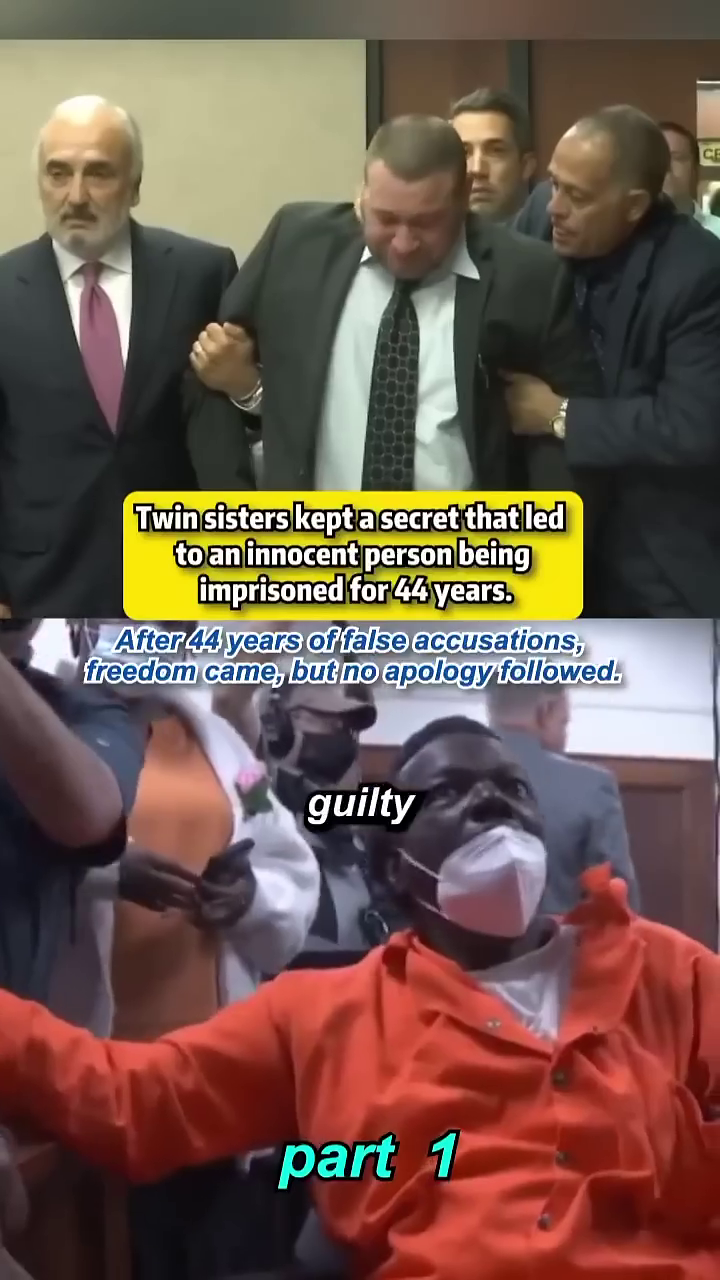
The American justice system, for all its ideals, is fundamentally a human endeavor. It is built on testimonies, circumstantial facts, and the deeply flawed process of memory and observation. When those human elements fail—or, worse, when they are intentionally manipulated—the results can be catastrophic. Few cases illustrate this profound failure more starkly than the decades-long ordeal of Vincent Simmons.
For 44 years, Simmons endured the unimaginable confines of prison, convicted of a heinous a-sault and battery he did not commit. His life, his freedom, and his future were stolen by a catastrophic convergence of judicial bias, questionable police procedures, and, most damningly, a lie told by two teenage twin sisters—a lie that shielded a private family secret at the expense of an innocent man’s entire existence.
The Trial That Started a Tragedy
The year was 1977. The air was thick with tension in the courtroom as the case against Vincent Simmons unfolded. The central and, ultimately, the most persuasive evidence against him was the identification by twin sisters, Karen and Sharon Sanders. They testified that Simmons was the man who had attacked and a-saulted them. Based almost solely on their compelling, yet ultimately false, testimony, Simmons was sentenced to an astounding 100 years in prison. His life sentence was, effectively, a death sentence for his freedom, locking him away for an atrocity he swore he never committed.
At the time, the identification by the victims was treated as irrefutable. The legal principle was simple: who knows the perpetrator better than those who endured the crime? However, even in the tense environment of the initial investigation and trial, the seeds of doubt were already sown, observable only to those willing to look past the surface narrative.
Red Flags and Institutional Bias
As the years ground on and Simmons repeatedly appealed his conviction from his cell, legal advocates and journalists began to unearth the numerous and glaring flaws that plagued the original investigation. These were not minor procedural errors; they were fundamental violations of due process and basic fairness that pointed toward a deeply biased pursuit of a conviction.
1. The Coerced “Confession”
One of the most disturbing revelations involved the circumstances of Simmons’ arrest. He was detained by a local Sheriff named Robert Laborde—who, critically, was the uncle of the accusers, Karen and Sharon Sanders. This clear conflict of interest should have immediately disqualified Laborde from the case. Instead, the investigation proceeded with him at the center.
Reports later indicated that Simmons was not only arrested without sufficient evidence, but that Laborde allegedly engaged in excessive physical force and brutality, resulting in a coerced confession. Under immense pressure and physical duress, Simmons was forced to admit to the crime. A confession obtained under torture or duress is legally invalid and profoundly unreliable, yet it became a linchpin in the prosecution’s case.
2. The Biased Lineup
Another critical failure occurred during the mandatory police lineup, a process designed to ensure fair identification. In this instance, Simmons was the only individual presented to the victims who was wearing handcuffs.
The standard procedure for a police lineup dictates that all participants must be dressed similarly and presented in an unbiased manner to prevent “suggestion” from influencing the victim’s choice. By singling Simmons out with restraints, the investigators essentially marked him as the presumed perpetrator. As the video summary suggests, this made him the “obvious target” for the twin sisters to “identify.” This procedural manipulation heavily weighted the outcome against Simmons, turning an identification process into a confirmation ritual.
The Twin Sisters’ Confession and the Real Secret
For decades, Vincent Simmons remained a prisoner, a name lost to the endless cycle of appeals and rejections, while the Sanders twins moved on with their lives. Yet, the truth, as it often does, eventually found a way to surface.
Years after the trial, one of the twin sisters, in a staggering moment of candor during an interview, revealed the devastating and racially prejudiced nature of her initial identification. She admitted that she could not be certain who had committed the crime, making the callous and racist claim that “all Black men looked the same.” This single statement destroyed the credibility of her and her sister’s eyewitness testimony, suggesting that Simmons was not identified because he was the attacker, but because he fit a general, preconceived description.
However, the complete and shocking reason for the lie was far darker than a simple case of mistaken identity.
A later, thorough reinvestigation of the case uncovered a deeply personal secret the sisters had desperately sought to conceal. The evidence suggested that the initial fabrication was not aimed at convicting an innocent man, but at covering up an “inappropriate relationship” between one of the twin sisters and their cousin, Keith Laborde (the son of Sheriff Robert Laborde).
The investigation reportedly found that the scratches and minor injuries one of the girls sustained—the injuries used to prove the attack—were not inflicted by a stranger. When the scratches were discovered, the girls were faced with a choice: reveal the nature of their involvement with their cousin, a secret that would have caused a social and familial explosion, or create a story that directed the blame elsewhere. They chose the latter, weaving a narrative that pointed away from their family and directly toward an unsuspecting, innocent man: Vincent Simmons.
Their decision to lie was a calculated act of self-preservation that tragically led to Simmons’ conviction. The lie was not simply a mistake; it was an active deflection of the truth that resulted in the complete destruction of another human being’s life.
Freedom, But No Apology
In the culmination of a decades-long legal battle, justice finally arrived for Vincent Simmons. In 2021, after serving 44 agonizing years in prison, a judge officially overturned his conviction. The weight of the contradictory evidence, the coerced confession, the biased lineup, and the sisters’ eventual admissions proved too overwhelming for the conviction to stand. Simmons walked out of prison an old man, free, but with four decades of his life forever lost.
His emotional release, captured in footage that shows him collapsing in joy and relief, was a moment of profound vindication. It was also a moment shadowed by a bitter truth: freedom came, but a genuine apology did not follow. Neither the Sanders sisters nor the institutions responsible for his wrongful conviction—the police department that coerced his statement, the prosecutor’s office that relied on the flawed evidence, or the state that incarcerated him—have offered a sincere, public act of contrition for the irreparable harm caused.
The lack of an apology underscores a deep failing in the criminal justice system: it is far better equipped to find fault than it is to admit error. The exonerated are often left to piece together the remnants of their lives, without financial compensation or moral acknowledgment from the system that broke them.
The Broader Implications of Simmons’ Case
The story of Vincent Simmons is more than an isolated tragedy; it is a critical case study that exposes systemic flaws requiring immediate attention and reform.
The Danger of Eyewitness Testimony
Simmons’ conviction highlights the danger of relying heavily on eyewitness testimony, especially when bias is present. Modern judicial reform movements have long advocated for better training and strict protocols to mitigate the known fallibility of human memory and the powerful influence of suggestion in police lineups.
Addressing Conflicts of Interest
The involvement of Sheriff Robert Laborde, the accusers’ uncle, is a textbook example of an unavoidable conflict of interest. Strict regulations must be enforced to ensure that investigating officers have no familial or personal stake in the outcome of a case, guaranteeing impartiality from the very first step of an inquiry.
Racial Bias in Identification
The sister’s later admission about the lack of distinction among Black men in her memory is a shocking, yet potent, reminder of how racial bias, both implicit and explicit, can contribute to wrongful convictions. The Simmons case serves as a painful illustration of how ingrained prejudices can lead to the targeting of Black men in the justice system.
A Life Stolen
Vincent Simmons’ decades in prison are a void that can never be filled. He lost the opportunity to build a career, marry, raise a family, and simply live as a free citizen. The compensation, should he receive any, will never truly account for the 44 years of birthdays, holidays, and everyday moments that were cruelly denied to him.
His freedom is a victory for justice, but his story remains a powerful, necessary condemnation of a system that allowed a teenage lie, fueled by bias and covered up by officials, to steal a man’s entire adult life. It is a cautionary tale, urging all to be vigilant in demanding truth, integrity, and accountability in every courtroom across the nation.