

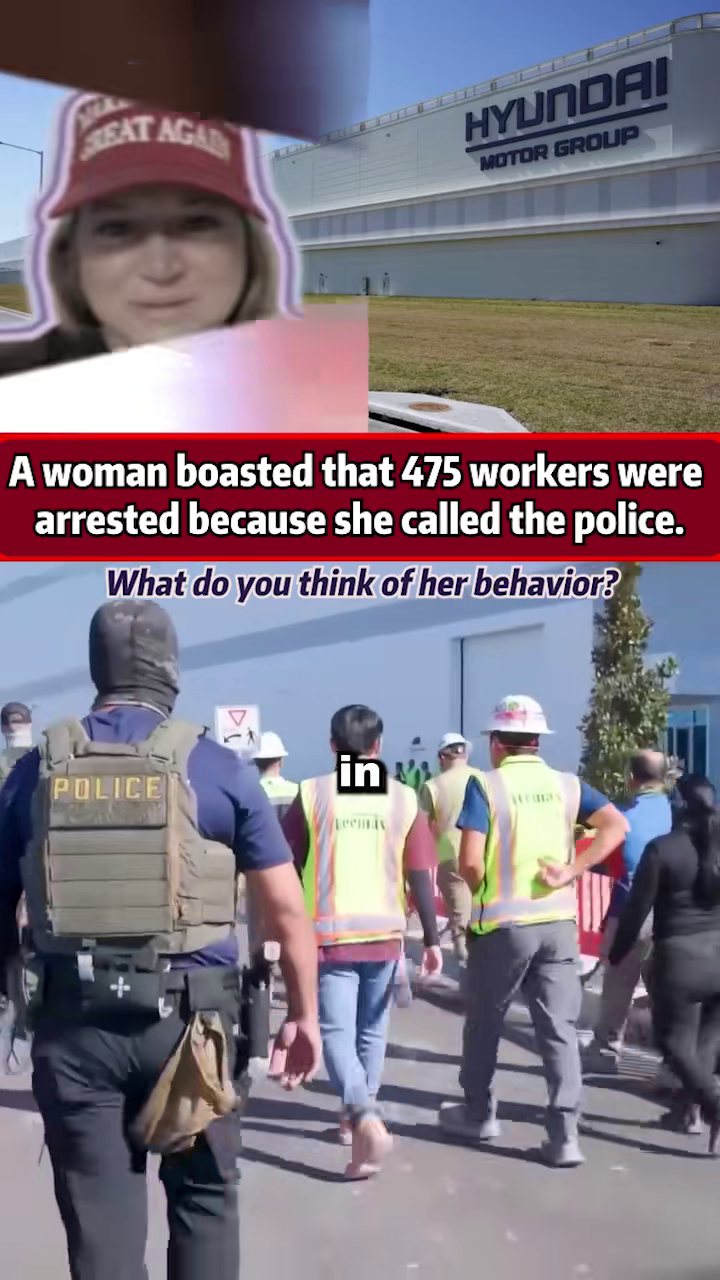
In the realm of political commentary and social media virality, a single online post can ignite a wildfire of real-world consequences. This is precisely what unfolded recently in Georgia, where a massive, multi-billion-dollar manufacturing project—poised to be one of the state’s most significant economic boosters in decades—has been thrown into serious jeopardy. The catalyst was a public boast by a political hopeful who proudly claimed responsibility for initiating an enforcement action that led to the apprehension of nearly 500 workers at the site.
The woman, running for a political office, saw her actions as a patriotic triumph—a move to combat perceived unfair labor practices and protect positions for local residents. However, many state and economic development officials now view the incident not as a victory, but as an act of profound self-sabotage, potentially costing the region not just construction progress, but an estimated 9,000 long-term manufacturing jobs. The controversy has exposed a dangerous friction point between rhetoric, policy, and the practical realities of large-scale international economic investment.
🏭 The Scale of the Investment
To understand the magnitude of the potential loss, one must first appreciate the scale of the Hyundai Motor Group Metaplant America in Bryan County, Georgia. Announced as a crucial component of the company’s electric vehicle (EV) strategy, the plant represents an estimated $7.6 billion investment. It is not merely an assembly line; it’s a colossal campus designed to house a significant portion of Hyundai, Genesis, and Kia’s EV and battery production for the North American market.
The projected economic benefits were staggering:
- Direct Jobs: An anticipated 8,100 direct, full-time manufacturing positions upon completion, later revised to closer to 8,500-9,000.
- Indirect Jobs: Thousands more positions expected in related supply chain industries, logistics, and local service sectors.
- Local Revenue: A massive increase in local tax bases, infrastructure development, and revitalization across the surrounding counties.
The project was heralded by Georgia officials as a crowning achievement, placing the state at the epicenter of the emerging US EV industry. The timeline was ambitious, with initial production targeted to begin in late 2024 or early 2025. Speed was of the essence, and to maintain that pace, Hyundai brought in highly specialized teams.
🇰🇷 The Role of Foreign Specialists
The video highlights a critical aspect of international manufacturing development: the use of specialized international personnel. Because the plant’s design, engineering, and equipment integration were managed by the Korean parent company, specialists from South Korea were reportedly brought in. Their role, as described in the video, was twofold:
- Oversight and Quality Control: To ensure the massive construction and equipment installation adhered to the exact specifications and proprietary processes developed by the company in Korea.
- Training and Knowledge Transfer: To train the first wave of American supervisors and technicians who would eventually manage and operate the sophisticated machinery. This “train the trainer” model is standard practice for complex international setups, ensuring a seamless transfer of complex industrial knowledge.
These specialized personnel are not meant to occupy the permanent, long-term jobs promised to American workers. Instead, they serve as temporary, expert consultants whose presence is vital for the successful launch and long-term viability of the operation. Their removal at a critical juncture could create bottlenecks that delay the project by months or even years.
🛑 The Enforcement and the Aftermath
According to the account presented in the video, the woman initiated contact with law enforcement, alleging issues related to the workforce at the site. This call led to an enforcement action in which, she proudly stated, 475 workers were taken into custody.
The immediate consequences of this mass removal were devastating to the construction schedule:
- Construction Halted: The highly specialized nature of the work meant that a sudden removal of nearly 500 expert personnel essentially froze progress on key areas of the plant.
- Loss of Expertise: The critical knowledge transfer process was abruptly severed, threatening the operational readiness of the plant once construction resumes.
- Reputational Damage: The incident created massive negative publicity, especially within the tight-knit world of global commerce and manufacturing.
The woman framed her action as a move to secure positions for local residents. However, the reality of the situation painted a far different picture: an act that dismantled the very infrastructure designed to create the promised permanent positions.
📉 The Real Cost: Economic Opportunity Lost
The most chilling consequence of the incident, as highlighted by the video, is the reaction of Hyundai’s investors and corporate leadership. Large-scale international projects are always subject to risk assessment. Factors include market demand, supply chain stability, and, critically, the political and regulatory environment of the host location.
A sudden, politically-motivated disruption that halts a $7.6 billion project sends a clear and alarming signal to corporate boards and investors: this location is unstable.
The state’s initial goal was the creation of a massive, long-term manufacturing hub. The irony is that the effort to seemingly protect jobs has now placed the entire project—and the 9,000 projected long-term jobs—in jeopardy. Economic development experts are now engaged in damage control, desperately trying to reassure the Korean company that the incident was an isolated event and that Georgia remains a safe and reliable place to conduct business.
The possibility of the entire project being canceled or substantially scaled back is now a very real threat. A cancellation would result in:
- A Massive Economic Loss: The state and local communities would forgo billions in investment, tax revenue, and the creation of a manufacturing ecosystem.
- Reputational Backlsh: Georgia’s hard-won reputation as a top destination for foreign direct investment (FDI) would be severely compromised, scaring away future companies that value predictability.
- The Loss of Future Jobs: The 9,000 promised jobs would simply vanish, replaced by an empty, partially completed factory shell.
🗣️ The Political Dimension: A Triumph of Rhetoric Over Reality
The video notes that the woman is running for Congress and is actively bragging about her role in the incident, framing it as a successful intervention. This indicates a profound disconnect between her actions and the resulting economic reality. In her narrative, she is a defender of American workers; in the view of many state leaders, she is the primary source of one of the biggest economic threats the state has faced in years.
This situation perfectly encapsulates the tension between populist rhetoric and the complex, global nature of modern manufacturing. While securing local jobs is a universally supported goal, the path to achieving it is rarely as simple as removing foreign workers. Global companies operate in integrated ways, and disrupting the necessary technical pipeline is an act of economic destruction, not protection.
The specialists were there to ensure the plant could operate, thus generating the thousands of jobs the political hopeful claimed to be fighting for. By disrupting this essential preparation phase, the individual’s actions demonstrate a failure to grasp the intricate mechanics of global-scale industrial development.
📈 Conclusion: The Price of Disruption
The controversy surrounding the Hyundai plant in Georgia serves as a powerful and unfortunate case study in the consequences of disruptive, politically motivated actions in the economic sphere. For a project representing a $7.6 billion commitment and 9,000 future jobs—the biggest economic opportunity the state had seen in years—the risk of cancellation is a staggering price to pay.
The long-term impact will not be measured by the number of workers temporarily removed, but by whether the plant ultimately opens its doors and fulfills its promise to the local community. If the project collapses, the incident will be remembered not as a political triumph, but as the moment an ambitious economic future for Georgia was deliberately undermined by those who claimed to be protecting it. The final decision by Hyundai’s investors will determine whether Georgia is seen as “America First,” or “Georgia Dead Last.”