

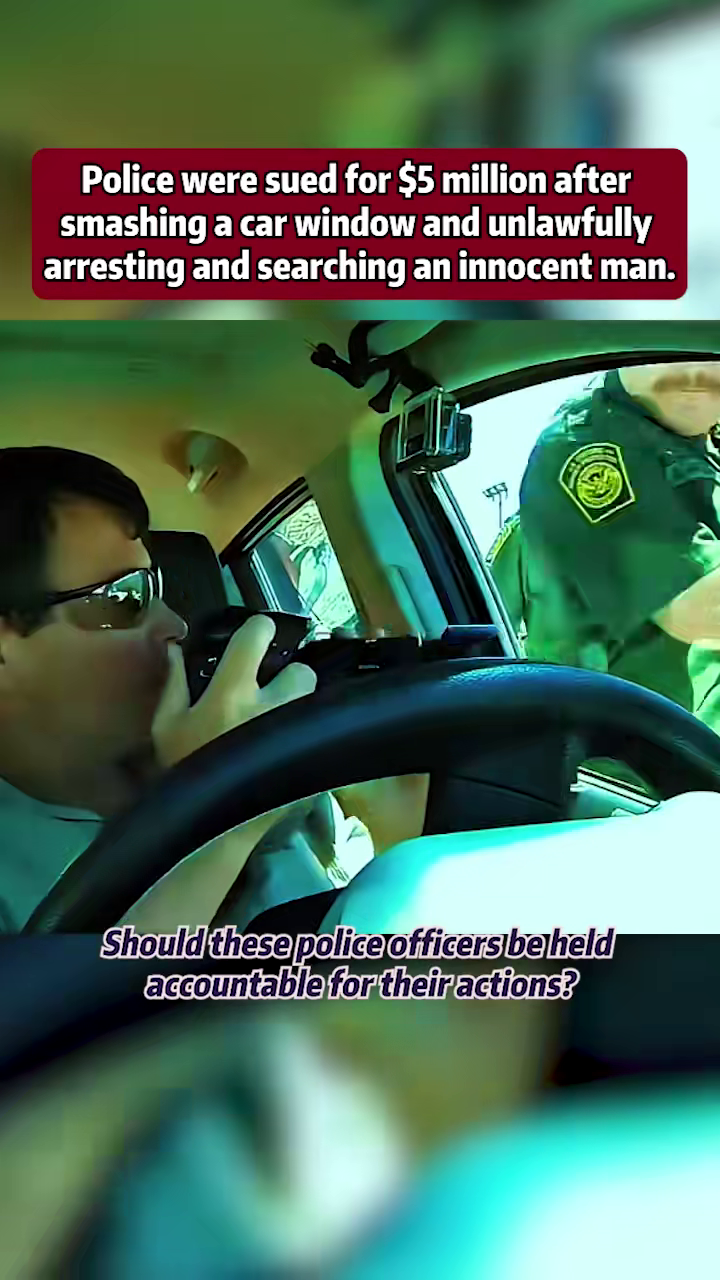
The relationship between law enforcement and the communities they serve has always been complex, but in recent years, one issue has consistently brought this tension to the forefront: police accountability, particularly in the digital age. A viral video circulating online provides a stark and deeply troubling example of this struggle, showing a group of heavily armed officers allegedly employing unjustified force against an individual who was simply documenting their activities from a distance. The incident culminated in a staggering $5 million lawsuit filed against the police department, reigniting a nationwide conversation about the boundaries of police power and the constitutional right of citizens to film in public spaces.
The footage in question is difficult to watch. It depicts a man sitting calmly in his vehicle, holding a camera and recording a distant police operation. His intent, as suggested by the ensuing public discussion, was to observe and document, a right firmly protected under the First Amendment. However, his act of recording was met with an immediate and aggressive escalation.
The Scene of the Confrontation
According to the video and subsequent reports, the man was maintaining his distance, posing no discernible threat to the officers or their ongoing activities. Yet, upon realizing they were being filmed, a contingent of multiple officers, described as heavily equipped, quickly converged on the lone, parked vehicle.
The events that followed demonstrated a clear, overwhelming, and, critics argue, completely unnecessary application of force. Without any evidence of a threat or non-compliance from the driver, one officer reportedly shattered the car window using an appropriate tool. The sound of the glass breaking and flying everywhere is a visceral reminder of the sudden violence of the encounter. The man was then forcibly removed from his car and immediately searched, an action later deemed by legal experts as an unlawful detention and search, given the lack of probable cause or reasonable suspicion that he was engaged in criminal activity.
This incident begs a profound question that lies at the heart of the police accountability movement: What is the appropriate response from law enforcement when a citizen is exercising their right to record?
The Right to Film: A Constitutional Guarantee
The right to record police officers engaged in their public duties is not merely a courtesy; it is a constitutionally protected activity. Multiple federal courts of appeals have affirmed this right, citing the First Amendment’s guarantees of free speech and freedom of the press. Filming law enforcement provides a crucial mechanism for transparency and oversight, serving as a powerful check on potential misconduct.
The Supreme Court has long recognized that public scrutiny is essential in a democratic society. As the saying goes, “sunlight is the best disinfectant.” Citizen videographers and body-worn cameras have played pivotal roles in bringing to light instances of excessive force and police misconduct that might have otherwise remained hidden or disputed.
In this particular case, the man was not interfering with the officers’ work, not crossing police lines, and not disobeying any lawful orders before the force was used. He was in his own vehicle, exercising a fundamental right. The officers’ reaction—shattering the window and detaining him—is seen by many as a clear act of intimidation and a gross infringement upon that right.
Abuse of Power and Display of Incompetence
The video’s narrator labels the incident a “blatant display of incompetence and abuse of power.” This assessment resonates with a public increasingly wary of an expanding police state mentality. The aggressive tactics used against a non-resisting individual—who was later confirmed to have been carrying nothing but a camera and had not broken any laws—suggest a troubling intolerance for oversight.
The actions appear to prioritize control and suppression of documentation over professional conduct and adherence to constitutional law. If officers can employ such overwhelming force and detain a person solely for filming, it creates a chilling effect on citizens who wish to hold them accountable.
Furthermore, the act of searching the man and his vehicle without finding any contraband or evidence of wrongdoing highlights the unjustified nature of the initial stop. The primary outcome of the police action was not the prevention of a crime, but the creation of a massive legal and public relations liability—the $5 million lawsuit.
The Question of Accountability
The central theme that emerges from this viral incident is the urgent need for robust police accountability. Lawsuits, while often a necessary path to financial redress for victims of misconduct, are generally borne by taxpayers and do not always ensure that the individual officers responsible for the actions are held professionally or criminally responsible.
In many instances of police misconduct, the internal processes for review and discipline are opaque and frequently fail to satisfy public expectations for justice. The public is demanding systems that enforce accountability in a meaningful way, including:
- Transparency in Investigations: Making internal affairs investigations and disciplinary records publicly accessible, subject to appropriate privacy safeguards.
- Independent Oversight: Utilizing independent review boards or special prosecutors to handle cases involving potential criminal activity by officers.
- Training and Policy Reform: Implementing mandatory, continuous training that emphasizes de-escalation, constitutional rights (especially the right to record), and the appropriate use of force.
- Civil Liability Reform: Re-evaluating qualified immunity laws that often shield officers from personal liability, making it difficult for citizens to seek justice in court.
The question posed in the video—“Should these police officers be held accountable for what they did?”—is rhetorical. In a just society, the answer is an unequivocal yes. Accountability is not an act of hostility toward law enforcement; it is a foundational pillar for maintaining the legitimacy and trust necessary for police to effectively perform their duties.
Fear of the Lens: Criminals vs. Cameras
Another pointed question raised by the incident is: Are the police more afraid of criminals or of being recorded?
The aggressive response to a man holding a camera suggests that, in the minds of some officers, the recording device is perceived as a greater immediate threat than the average criminal encounter. A camera documents reality, leaving an objective, immutable record that can contradict an officer’s narrative. This is precisely why recording is so vital to public safety and civil rights; it provides the unvarnished truth necessary to adjudicate cases of misconduct.
The fear of the lens is, fundamentally, a fear of transparency. This fear leads to reactionary measures like the one seen in the video, which only further erode the public trust that law enforcement claims to uphold. When officers act as if they are above scrutiny, they demonstrate a profound misunderstanding of their role as public servants. The public expects and demands that police operate within the confines of the law, and the video camera is an essential tool in ensuring that they do.
The Broader Impact and Moving Forward
The $5 million lawsuit is more than just a large financial settlement; it is a symbol of the cost of unchecked power. It represents the psychological and constitutional harm inflicted on the victim, the loss of taxpayer dollars, and the further splintering of community trust.
For meaningful progress to occur, there must be a shift in police culture that values constitutional compliance and transparency over control and intimidation. The right to film is a non-negotiable component of civil liberty. Law enforcement agencies must proactively train their personnel to recognize and respect this right, viewing citizen recordings not as a challenge to their authority, but as a potential mechanism for exoneration and improved public relations.
In conclusion, this highly publicized incident serves as a critical warning sign. It underscores that police misconduct, even in cases where no physical harm is immediately apparent (such as an unlawful detention and property damage), carries a severe cost. The public’s demand for accountability, fueled by incidents like this one, will continue to grow until tangible, systemic changes are made to ensure that no citizen is ever subjected to such an unjustified use of force simply for holding a camera. The hope is that the price paid in this lawsuit will force a necessary re-evaluation of tactics, training, and the very culture of law enforcement.