

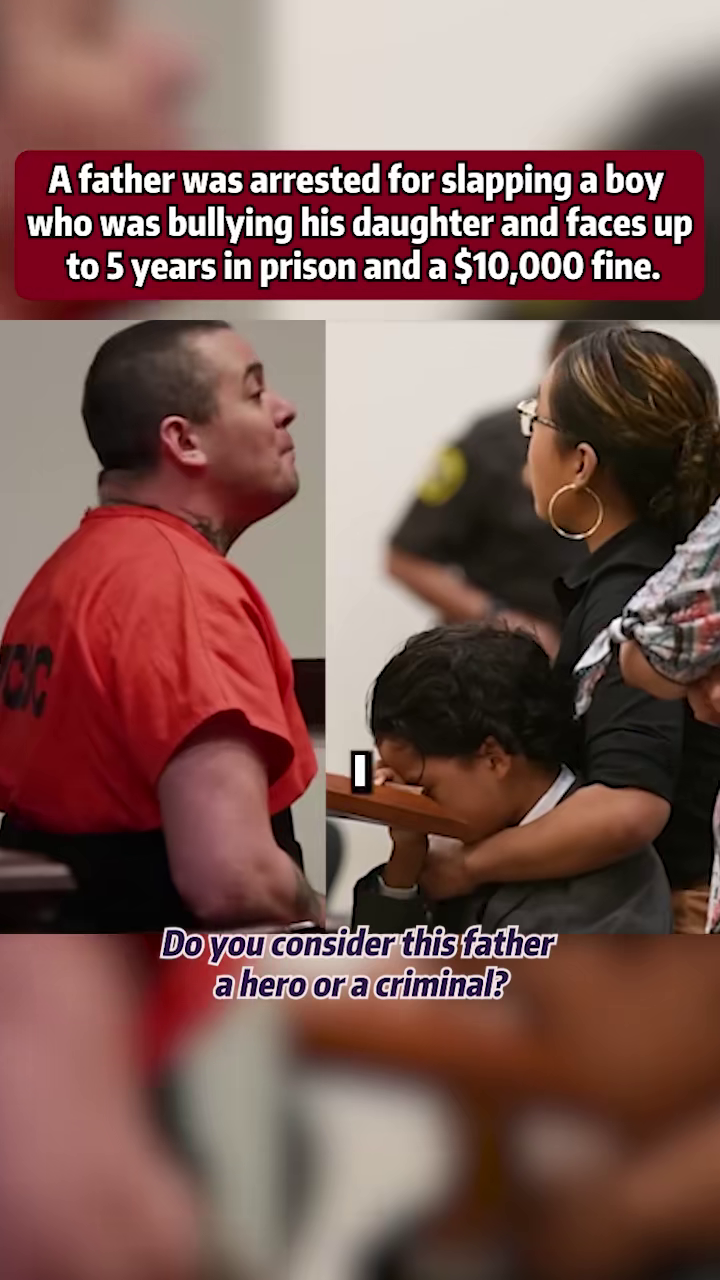
The story of a father, James Peace, who was arrested and charged with injury to a child after physically confronting his daughter’s alleged bully, has ignited a fiery debate across social media and communities nationwide. The heart of the matter lies in a fundamental conflict between a parent’s primal instinct to protect their child and the legal boundaries governing physical altercations.
The incident, which reportedly took place after a prolonged period of severe bullying targeting Peace’s 12-year-old daughter, Presley, has forced the public to grapple with a deeply emotional and complex legal and ethical dilemma. Is James Peace a courageous hero who stood up for his child where the system failed, or a criminal who escalated violence and took the law into his own hands?
This comprehensive article delves into the details of the case, explores the arguments surrounding the father’s actions, examines the severe legal implications he now faces, and discusses the broader conversation this incident has sparked regarding school safety, anti-bullying measures, and the role of parents, schools, and the justice system.
💔 The Agony of a Bullied Child: Presley’s Story
To understand the intense emotional pressure that may have led to James Peace’s actions, one must first grasp the severity of the alleged bullying Presley endured. According to reports from the family, Presley, a 12-year-old girl, had been a target of persistent verbal and behavioral harassment by a male classmate.
The torment was not trivial or isolated. Reports suggest the classmate openly mocked her appearance and used insulting language. Crucially, the bullying escalated to physical acts, including a reported incident where the aggressor threw ice cream at her in front of other students. These daily humiliations and aggressions reportedly took a significant toll on Presley’s emotional well-being, often leading her to tears before school.
The family reportedly attempted to seek recourse through official channels before the physical confrontation occurred. The specific details of what interventions, if any, the school had taken or failed to take remain central to the father’s defense and the public’s perception of his motivation. Many argue that a parent’s desperation grows proportional to the perceived failure of institutions—like the school—to provide a safe environment for their child. When a child is consistently victimized, and official avenues seem ineffective, the feeling of helplessness can become overwhelming, potentially leading to desperate measures.
James Peace’s own stated motivation reflects this desperation. He insisted, “I didn’t mean to hurt the child, but I will fight for my daughter’s dignity.” He also admitted that upon seeing the continued harassment, he “lost control,” feeling he had to make the bully “understand that it’s wrong to bully others.” This suggests an act born out of profound frustration, a protective instinct, and a desire to enforce a sense of justice or consequence that he believed was lacking.
🚨 The Confrontation and the Charges
The father’s decision to confront the bully directly led to his arrest. Surveillance video reportedly shows James Peace confronting the boy as he walked home from school and administering a slap that knocked the boy’s headphones off.
Following the incident, police investigated and subsequently arrested James Peace. He was charged with injury to a child, a serious offense with potentially life-altering consequences.
The maximum penalty Peace faces is severe:
-
Up to five years in prison.
-
A $10,000 fine.
The charge itself highlights the core of the legal problem. While Peace’s intent may have been to protect his daughter and stop the bullying, the act of a grown man physically striking a juvenile is categorized as a crime, regardless of the prior circumstances. The law strictly prohibits an adult from administering corporal punishment or physical injury to a child who is not their own, even under claims of self-defense or defense of others. The boy’s family, or the state acting on their behalf, is treating this as an unprovoked assault by an adult on a minor.
⚖️ Legal Analysis: Intent vs. Action
The legal system often struggles with cases where public sympathy clashes with codified law. In James Peace’s case, the defense would likely center on the concept of justification or necessity, arguing that his actions were a reasonable, albeit regrettable, response to protect his daughter from ongoing harm that others failed to prevent.
-
The Prosecution’s Case: The prosecution will focus on the clear-cut facts: an adult physically struck a minor. The charge of injury to a child does not typically require proving intent to severely m-m or cause lasting physical d-m-g. It simply requires proof that the adult caused physical p-in or i-j-ry to a child. The prior actions of the bullied boy, while morally reprehensible, do not legally justify the father’s battery. Furthermore, the prosecution would argue that allowing parents to administer physical p-n-shm-nt to children who bully their own would lead to vigilante justice and social chaos, undermining the established legal and school disciplinary systems.
-
The Defense’s Argument: The defense would lean heavily on the context of the relentless bullying and the alleged failure of the school to provide a safe environment. They might attempt to use the concept of defense of a third party, though this is typically reserved for immediate threats of physical h-rm, not delayed confrontation over emotional/verbal abuse. They would also try to convince the jury or judge that a non-custodial p-n-shm-nt in this specific context should be viewed differently due to the extreme provocation and the father’s pure, protective intent. They would argue for leniency, probation, or a reduced charge, emphasizing the father’s history as a dedicated parent and the immense community support he has received.
The fact that Peace was physically defending his daughter’s “dignity,” not her immediate physical safety at that moment, complicates a classic self-defense claim. His action, taking place after the school day, appears more as retribution or a form of parental p-n-shm-nt, rather than an act of immediate necessity. This distinction is critical in a court of law.
🗣️ The Public Verdict: Hero or Criminal?
The public reaction to the case has been overwhelmingly in support of James Peace, creating a powerful narrative where he is viewed as a hero for protecting his daughter.
👍 Arguments for “Hero”
-
Systemic Failure: Many believe Peace acted because the school system and other authorities had failed to protect his daughter. His action is seen as a necessary last resort when institutions are inadequate.
-
Protective Instinct: His behavior is viewed as the ultimate expression of parental love and the instinct to protect one’s offspring. Supporters argue that any parent would feel compelled to act under similar circumstances.
-
Restoring Dignity: For many, the slap symbolized a necessary forceful boundary, communicating clearly to the bully that his actions had consequences and that Presley was not a defenseless target.
-
Community Support: The father’s supporters have rallied around him, viewing his mugshot “not as a mark of shame, but as a badge of honor for protecting his daughter.”
👎 Arguments for “Criminal”
-
Vigilante Justice: Opponents argue that no matter the justification, taking the law into one’s own hands is unacceptable and undermines the rule of law.
-
Adult on a Child: The immense power and size difference between an adult and a 12-year-old child make the physical act inherently disproportionate and dangerous. An adult should never strike a child who is not their own.
-
Setting a Dangerous Precedent: Allowing such behavior, even with sympathetic motives, could encourage others to resort to violence instead of legal avenues, potentially leading to more serious h-rm.
-
Escalation of Violence: Critics argue that violence, even when motivated by a desire to stop violence, only perpetuates the cycle. The adult should have sought dialogue with the parents or legal remedies.
🏛️ The Broader Conversation on Bullying and Parental Response
This case serves as a stark reminder of the widespread epidemic of bullying and the emotional toll it takes on victims and their families.
The Role of Schools
The core issue that often drives parental desperation is the perceived ineffectiveness of school anti-bullying policies. Policies are often in place, but implementation can be inconsistent. When schools are seen as prioritizing bureaucratic processes over a child’s safety, parents feel they must step in. This case should prompt schools to:
-
Review and reinforce anti-bullying protocols.
-
Ensure timely and effective intervention.
-
Establish clear, supportive channels for parents to report issues.
-
Focus on rehabilitative measures for bullies, not just p-n-shm-nt.
Healthy Parental Responses
While James Peace’s actions were driven by love, the legal system and child safety advocates would advise parents to pursue alternatives to physical confrontation, such as:
-
Documenting Everything: Meticulously record every incident, communication with the school, and the child’s emotional state.
-
Seeking Legal Counsel: Consult an attorney regarding options like protective orders or filing a formal complaint against the aggressor’s family.
-
Formal Mediation: Request formal mediation or a meeting with the school, the bully’s parents, and school administrators present.
-
Therapeutic Support: Focus on getting immediate emotional and psychological support for the victimized child.
✅ Conclusion: An Unwinnable Situation
The case of James Peace presents an almost unwinnable situation, legally and morally. His conviction would send a chilling message to parents that they must stand by while their children are tormented, trusting in a system that may have demonstrably failed them. His acquittal, on the other hand, could be interpreted as a green light for vigilante justice, undermining civil and criminal law.
In the eyes of the law, he is currently a defendant facing serious criminal charges for physically striking a minor. In the court of public opinion, he is a man who made a desperate stand for his daughter’s dignity and safety. Ultimately, the outcome of this case will not only determine the father’s future but will also serve as a landmark moment in the ongoing national conversation about the limits of parental protection and the consequences of systemic failure in the face of relentless bullying.