

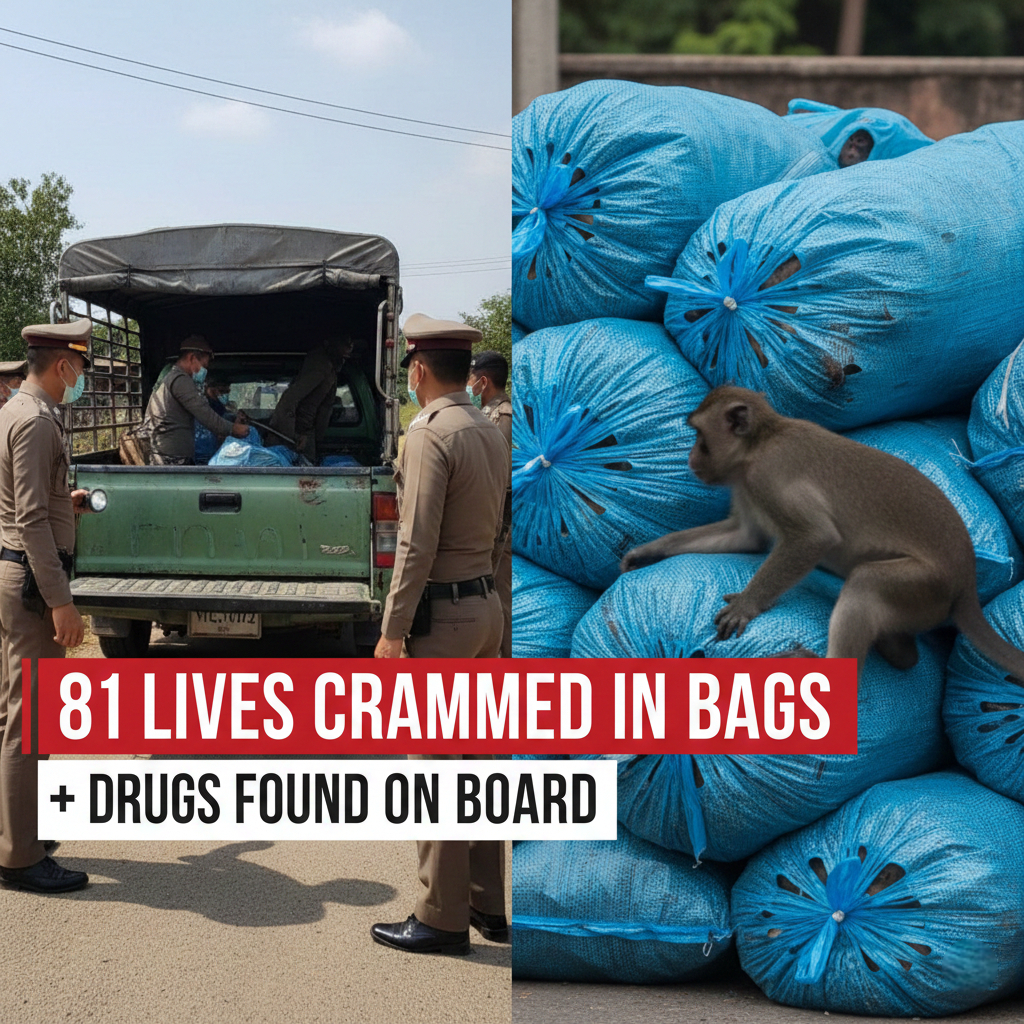
SA KAEO, THAILAND — In a disturbing discovery that highlights the growing intersection between narcotics and wildlife crime, Thai police have arrested two men caught smuggling dozens of live monkeys alongside a cache of illegal drugs.
The interception, which took place in the Aranyaprathet district of Sa Kaeo province near the Cambodian border, uncovered 81 long-tailed macaques stuffed into cramped mesh bags. The animals, many of whom were in a state of severe distress, were destined for cross-border export, likely feeding into the lucrative international black market for laboratory test subjects and exotic cuisine.
This incident is the latest in a string of high-profile busts that underscore Thailand’s critical role as a transit hub for transnational organized crime.
The Interception
Acting on a tip-off regarding a suspicious vehicle, rangers from the 12th Ranger Forces Regiment, in coordination with local police, set up a checkpoint along a known smuggling route. On Friday afternoon, a pickup truck matching the description approached the border zone.
When authorities stopped the vehicle for inspection, the driver and his passenger appeared visibly nervous. A search of the truck’s cargo bed revealed a harrowing scene: piles of blue plastic mesh bags, writhing with movement. Inside, officers found 81 macaques, their limbs bound and bodies compressed to maximize space.
“The animals were packed so tightly that they could barely breathe,” stated a ranger involved in the operation. “It is a standard method for traffickers who view these living creatures as nothing more than cargo.”
In addition to the wildlife, a search of the suspects’ personal belongings and the vehicle cabin yielded another illicit find: a quantity of methamphetamine pills and crystal meth. While the exact amount of narcotics was not immediately released to the public, it was sufficient to trigger additional charges under Thailand’s strict anti-narcotics laws.
“Meth and Monkeys”: A Toxic Combination
The discovery of methamphetamine alongside trafficked wildlife is becoming an increasingly common pattern in Southeast Asia. Law enforcement officials note that “yaba” (meth pills) are frequently used by couriers to stay awake during long, overnight drives to border crossings. In some darker instances, traffickers have been known to sedate animals with human drugs to keep them quiet at checkpoints, though it is unclear if that was the case in this specific incident.
The two suspects, whose names were withheld pending further investigation, reportedly confessed during initial interrogation. They admitted to being hired to transport the macaques from central Thailand to the Cambodian border. From there, the animals were expected to be moved by a separate network, likely heading toward Vietnam or China.
The men have been charged with multiple offenses, including the illegal possession of protected wild animals and possession of Grade 1 narcotics.
The Plight of the Long-Tailed Macaque
The victims of this operation—the long-tailed macaques (Macaca fascicularis)—are at the center of a global conservation crisis. Once ubiquitous across Southeast Asia, the species has seen its population plummet in recent years due to relentless poaching.
In 2022, the International Union for Conservation of Nature (IUCN) upgraded the status of the long-tailed macaque to Endangered, citing a “devastating” decline in numbers.
The driving force behind this trade is largely the global biomedical research industry. Long-tailed macaques are the most traded non-human primate for toxicity testing and medical research. following the disruption of supply chains during the global pandemic, the price of a single macaque skyrocketed to tens of thousands of dollars in Western markets.
This price surge has incentivized criminal syndicates to snatch wild monkeys from Thailand’s forests, laundering them through fake breeding facilities or smuggling them directly across borders.
“The demand is insatiable,” explains a regional wildlife monitor. “When a single monkey can fetch a year’s salary for a poacher, the incentive to commit these crimes is incredibly high. The risk of arrest is often seen as just a cost of doing business.”
A Grueling Journey
For the 81 monkeys rescued in Sa Kaeo, the journey was a nightmare. Traffickers typically trap entire troops using nets, separating mothers from infants. They are then shoved into the mesh bags seen in this bust—often without food or water for days.
Veterinarians who examined the rescued animals reported signs of dehydration, physical trauma, and extreme stress. Sadly, in operations like this, it is common for a percentage of the animals to perish before they even reach their destination. Authorities are currently providing emergency care to the survivors at a government wildlife quarantine center.
Those that survive the trafficking route often face a grim fate. While many are destined for labs, others are sold into the exotic pet trade or slaughtered for traditional medicine and “wild meat” restaurants in neighboring countries.
The suspects in this case allegedly viewed the animals merely as units of profit. The callous nature of the transport—stacking living beings like sacks of rice—demonstrates the total lack of empathy involved in the trade.
Thailand’s Crackdown on Wildlife Crime
Thailand has long been a transit point for wildlife smuggling, but the government has ramped up efforts to shed this reputation. The Royal Thai Police, specifically the Natural Resources and Environmental Crime Suppression Division (NED), has been working closely with international agencies like the U.S. Fish and Wildlife Service to dismantle these networks.
This bust in Sa Kaeo is part of a broader crackdown. Just days prior, authorities in a neighboring province intercepted another shipment, signaling a coordinated spike in trafficking activity—or perhaps, better enforcement.
However, the challenge remains immense. The borders between Thailand, Cambodia, Laos, and Myanmar are porous, filled with unofficial crossings that smugglers exploit. The addition of drug trafficking into the mix complicates enforcement, as wildlife rangers often find themselves outgunned by cartels moving both animals and narcotics.
Legal Consequences and Future Outlook
The two men arrested face severe penalties. Under Thailand’s Wild Animal Reservation and Protection Act, trafficking protected species can carry a prison sentence of up to 10 years and a fine of up to one million baht (approx. $28,000 USD). The narcotics charges could add significant jail time, potentially keeping these individuals behind bars for decades.
Yet, conservationists argue that arresting the drivers is not enough. The “kingpins” who order the monkeys and finance the operations often remain untouched, insulated by layers of middlemen.
“We need to follow the money,” says a representative from a local NGO. “Arresting the driver stops the truck, but it doesn’t stop the trade. We need to identify who is buying these monkeys and shut down the illegal breeding farms that launder them.”
What Happens to the Rescued Monkeys?
For the 81 survivors, the road to recovery is long. They will undergo disease screening—macaques can carry herpes B and tuberculosis, which poses risks to humans and other animals. Once cleared, they will likely be moved to a wildlife sanctuary.
Releasing them back into the wild is difficult. Macaques are highly social and territorial; dumping a random group of traumatized monkeys into an existing forest can lead to conflict with resident troops. Many of these animals may spend the rest of their lives in sanctuary care, safe from the trade but forever removed from their natural freedom.
Conclusion
The arrest of two men with “monkeys, meth, and mesh bags” is a stark reminder of the brutality hidden behind the wildlife trade. It exposes a criminal underworld where lives are commodified and sold to the highest bidder.
As Thai authorities continue their investigation, the hope is that this bust will lead to further arrests up the chain of command. For now, 81 lives have been spared a horrific fate, but thousands more remain at risk in the forests of Southeast Asia.