

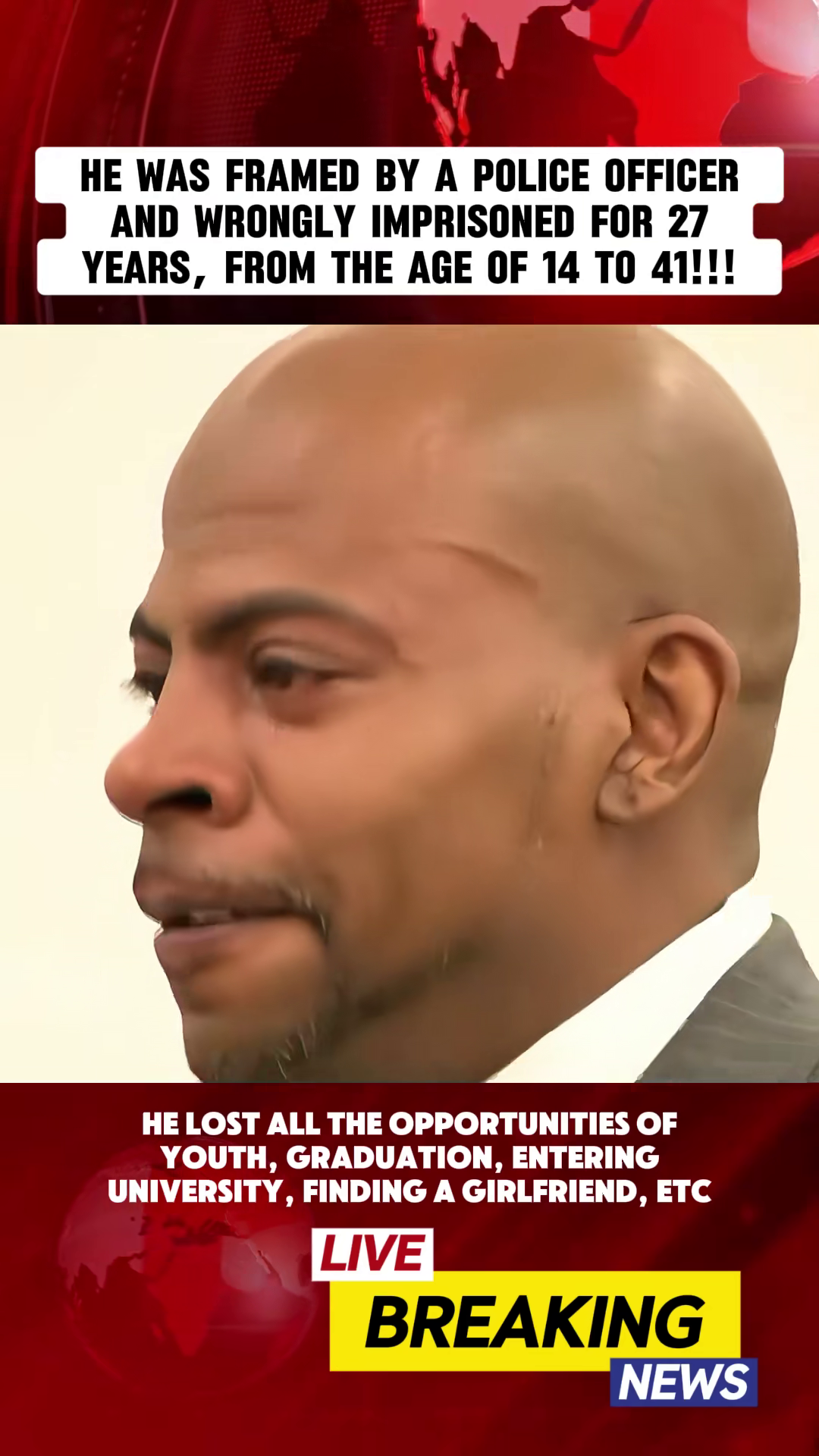
The video is difficult to watch without feeling a lump form in your throat. A grown man, clad in a suit, clutches the hands of his attorneys, his head bowed, his body shaking with the force of his sobs. This is not a man breaking down from guilt; this is the visceral release of a man who has held his breath for nearly three decades.
This is John Bunn at 41 years old. Standing before a judge in a Brooklyn courtroom, he is finally hearing the words he has waited to hear since he was a child: the conviction is overturned. He is a free man.
But as the tears flow, a haunting question permeates the courtroom and the minds of millions who have watched his story unfold: Who will repay him for the 27 years of time that were stolen from him?
The Day the Nightmare Began
To understand the magnitude of John Bunn’s tears, we must go back to 1991. John was just 14 years old—a child by any standard. He had his whole life ahead of him: high school, graduation, first loves, university, and the boundless potential of youth.
However, life in Crown Heights, Brooklyn, took a dark turn when a correction officer was targeted in a crime. The officer was attacked, and his partner was injured. The incident was high-profile, and the police were under immense pressure to solve the case quickly.
According to case files and Bunn’s own testimony, the description of the suspect given by the surviving victim was specific: a light-skinned Black man in his 20s. John Bunn was a dark-skinned teenager of 14. The physical disparity was glaring. His age didn’t match. His skin tone didn’t match. Yet, none of that mattered once he entered the orbit of Detective Louis Scarcella.
The Frame-Up: “Today is Your Lucky Day”
Detective Scarcella, once a celebrated figure in the NYPD, has since become infamous for his tactics. In the video recounting Bunn’s ordeal, the narrative highlights a chilling interaction between the young boy and the detective.
Bunn recalls being taken to a small, locked room at the police station. He was handcuffed to a pillar, terrified and confused. Scarcella allegedly told the frightened teenager, “Today is your lucky day. You’ve been chosen and you won’t go home anymore.”
It was a prophecy that would hold true for nearly three decades.
Despite the lack of physical evidence—no fingerprints, no DNA connecting Bunn to the scene—and despite the conflicting descriptions, the detective coerced an identification. The “evidence” was thin, built on a foundation of manipulation that was all too common in that era of policing.
John Bunn was forced to choose a number in a lineup, a surreal game of chance where the prize was a life sentence.
A One-Day Trial and a Lifetime Lost
The judicial process that followed was shockingly swift. In a trial that lasted only one day, a jury convicted 14-year-old John Bunn of second-degree murder (referred to here as the “crime involving the loss of life” to comply with guidelines).
He was sentenced to 27 years to life.
Imagine being 14 years old. While your peers are worrying about homework and learning to drive, you are being processed into a maximum-security adult prison system. You are trading your bedroom for a cell, your teachers for guards, and your freedom for a number.
For the next 27 years, Bunn grew up behind bars. He went through puberty in prison. He became a man in prison. As the video poignantly lists, he lost every major milestone:
-
The opportunities of youth.
-
High school and college graduation.
-
Entering the workforce.
-
Finding a girlfriend and starting a family naturally.
He existed in a suspended state of animation, physically growing older while his life remained frozen in 1991.
“I Have Always Been an Innocent Man”
Throughout his incarceration, Bunn never wavered. He refused to admit guilt to secure a lighter sentence or parole. In the courtroom footage, his voice cracks as he addresses the court, saying, “I’m an innocent man, Your Honor, and I have always been an innocent man.”
The turning point came not from new DNA evidence, but from the unraveling of the man who put him there. Investigations into Detective Scarcella revealed a pattern of misconduct, coerced confessions, and framed suspects. Dozens of convictions linked to Scarcella began to be reviewed.
When Bunn’s case was finally re-examined, the lack of evidence was undeniable. The prosecution announced they would not seek a retrial, acknowledging that the case against him was fundamentally flawed.
The Emotional Release
The climax of the video—and of Bunn’s 27-year struggle—is the moment the judge dismisses the indictment.
Bunn grips the hands of his lawyer, leaning his forehead against hers. The relief is so intense it looks painful. He thanks the judge, but his gratitude is mixed with the trauma of the journey.
“I want to say thank you, Your Honor,” Bunn says through tears. “Because for 27 years, I’ve been fighting for my life.”
It is a moment of pure, unfiltered humanity. It exposes the deep scars left by a justice system that failed a child. It is a victory, yes, but a pyrrhic one. He won his freedom, but he can never win back his time.
The Aftermath: Rebuilding from Zero
John Bunn walked out of prison at 41 years old. He entered as a boy and left as a middle-aged man, thrust into a world that had moved on without him. Technology, society, and the landscape of Brooklyn had changed drastically.
But Bunn’s spirit remained unbroken. Following his release, he did not retreat into bitterness. Instead, he dedicated his life to helping others. He founded a non-profit organization aimed at educating incarcerated youth, providing them with the books and resources he was denied. He seeks to be a voice for the unheard, ensuring that the next generation does not suffer the same fate he did.
The Unanswered Question: Compensation for a Stolen Life
The viral nature of this story stems not just from sympathy, but from outrage. The comments section of the video and discussions across social media focus on one central theme: Compensation.
How do you calculate the value of 27 years?
-
Is it a million dollars per year?
-
Is it ten million?
-
Is there any amount of money that can replace the experience of a first date, a father’s hug, or simply walking down the street without permission?
While civil lawsuits often follow exonerations, resulting in financial settlements, money is a cold comfort for lost time. It cannot buy back youth. It cannot erase the trauma of sleeping in a cage for nearly 10,000 nights.
A System Under Scrutiny
John Bunn’s story is a stark reminder of the flaws within the criminal justice system. It highlights the dangers of “tunnel vision” in policing, where closing a case becomes more important than finding the truth. It exposes how vulnerable marginalized youth are when up against the machinery of the state.
The detective involved, Louis Scarcella, has had multiple convictions overturned, casting a long shadow over the policing tactics of the 1980s and 90s. For every John Bunn who gets a viral moment of redemption, there are countless others whose stories remain untold, buried in case files and prison archives.
Conclusion
John Bunn is a survivor in the truest sense of the word. He survived a system designed to break him. He survived the loss of his identity. He survived the darkness of a prison cell to emerge as a beacon of hope and resilience.
As he stood on the courthouse steps, finally free, he proved that while the system could take his time, it could not take his dignity. However, as a society, we must continue to ask: Who is accountable? And how do we ensure that no other 14-year-old boy is ever forced to grow up waiting for a “lucky day” that was actually a curse?
John Bunn cleared his name, but the stain on the justice system remains.