

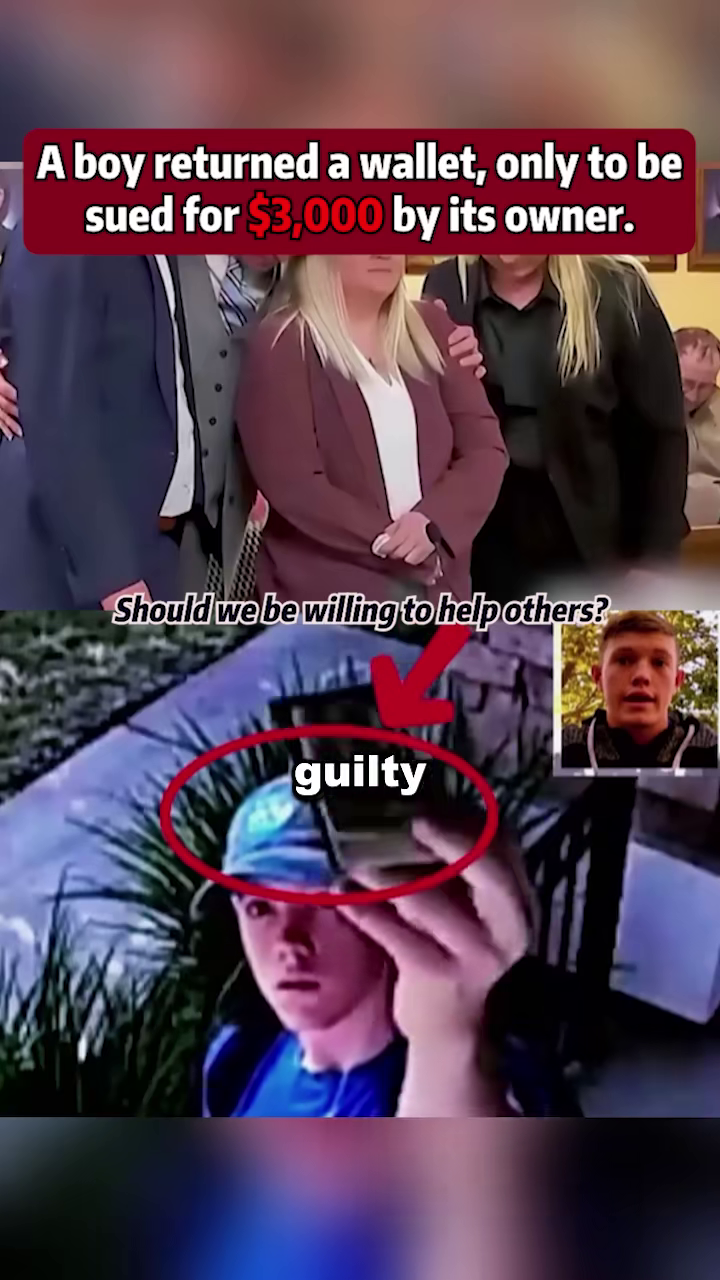
The story of 17-year-old Adrian is a modern-day parable that has sparked a fierce ethical debate across the internet and legal circles. It’s a tale of simple, commendable honesty twisted into a painful legal burden, forcing us to confront a difficult question: In an era often cynical about human nature, is the risk of doing the right thing sometimes too great?
Adrian’s ordeal began innocently enough. On a regular afternoon, he discovered a handbag in a supermarket parking lot—a moment many of us have faced, presenting an immediate moral crossroads. Inside the bag was not just identification and credit cards, but a substantial amount of cash, reportedly $10,000. For a teenager, or anyone, this represents a life-altering sum. Adrian, however, chose the path of high integrity. He decided to find the owner and return the entire bag, cash and all.
His commitment to honesty was so firm that he went the extra mile, driving a significant distance—more than 10 kilometers—to hand the wallet directly back to the woman who lost it. He walked away, expecting perhaps a simple word of thanks, a small reward, or at the very least, a clear conscience. What happened next would upend his life and challenge the very notion of a “good deed.”
From Hero to Suspect: The Lawsuit
Instead of gratitude, Adrian was met with accusation. Shortly after the return, the owner of the handbag contacted law enforcement. She didn’t report that her entire bag was missing; she reported that while the bag had been returned, $3,000 of the cash was missing.
Suddenly, Adrian, the Good Samaritan, was cast as the prime suspect.
The owner swiftly moved to civil litigation, demanding that Adrian repay the “lost” $3,000. In an instant, his act of integrity transformed into a legal and financial threat. Adrian was in shock. He insisted he had returned everything, having never even considered taking a penny. But in the eyes of the law, and the accusatory owner, his good intentions were irrelevant. He was now forced to defend himself against a claim of theft—a charge that, while civil in nature, carried the devastating weight of moral condemnation.
The Legal Quagmire: Proving a Negative
The core problem for Adrian lay in the fundamental nature of proof. He was being asked to prove a negative—that he did not take the money. The owner claimed a loss; Adrian claimed he returned the full amount.
- Absence of Evidence: Because Adrian had performed his good deed without witnesses or a pre-emptive record of the contents, there was no objective evidence to corroborate his side of the story.
- The Police’s Dilemma: When law enforcement was involved, they were unable to determine the truth. They had a conflicting account from the owner and a defense of innocence from Adrian. Without concrete proof, they couldn’t definitively label the situation a crime or a false accusation.
- Civil Litigation: The case moved out of criminal court and into civil litigation, where the standard of proof is lower, making it a “he said, she said” battle that could ruin the young man’s financial future.
This impasse highlighted a chilling reality: in situations involving lost property and cash, even the most honest person can become ensnared in a legal trap if they fail to protect themselves with due diligence.
The Internet Erupts: A Fierce Debate on Kindness
When the story went public, it immediately became a viral sensation, fueling an intense, often acrimonious, debate across social media and online forums. The public reaction split into two main camps:
Camp 1: The Cautionary Tale
Many users reacted with anger and disappointment, seeing Adrian’s experience as proof that performing good deeds is simply too risky. Comments ranged from “This is why I’d just leave it” to “Kindness gets punished.” This group lamented the possibility that this incident would discourage others from acting honorably, leading to a more callous society where no one risks helping a stranger. They viewed the owner as deeply ungrateful, perhaps even malicious, for capitalizing on Adrian’s integrity.
Camp 2: The Due Diligence Advocates
A more pragmatic, though less sympathetic, group argued that while Adrian’s intentions were pure, his execution was flawed. They emphasized the importance of self-protection. Their central argument was that in any transaction involving substantial cash, one must secure proof. “He should kll the return,” or “He should have called the police first,” were common refrains. This camp, while not excoriating Adrian, focused on the judicial and practical necessity of maintaining evidence.
The Judge’s Verdict: Intentions vs. Documentation
Adding to the gravity of the public conversation, a judge (perhaps commenting on a similar case or the principle at large) offered a powerful piece of advice that summarized the legal lesson of Adrian’s situation:
“No matter how good your intentions are, you should always keep a record of your actions.”
This statement cut to the heart of the matter. While morality champions good intentions, the legal system relies on verifiable facts and evidence. An individual’s state of mind—their “good intentions”—cannot stand up in court against an unproven financial claim without documentation.
For anyone who finds lost property, particularly cash, this is the crucial takeaway. A simple act of calling the police and having an officer inventory the bag’s contents before it is returned creates an objective, third-party record. Handing over property in private, as Adrian did, leaves no paper trail and provides no protection.
A Call for Clearer Good Samaritan Protections
The incident also prompted discussions about existing “Good Samaritan” laws. These laws primarily exist to protect people who offer medical aid during emergencies from liability for unintentional harm. However, they rarely extend to the return of lost property.
This raises a compelling legislative question: Should there be clearer legal protections for individuals who act in good faith to return valuable lost property? A legal framework that provides immunity from liability for civil claims like the one Adrian faced, provided the finder has taken reasonable steps (like immediately reporting the find to the police or a public authority), could encourage honesty without exposing citizens to undue legal risk.
The Lingering Shadow of Distrust
Ultimately, Adrian’s plight is a deeply tragic one because it highlights the vulnerability of the honest person. His quiet statement at the end of the video sums up the emotional cost:
“I just wanted to do the right thing. I never thought I’d end up being treated like a thief.”
His genuine desire to act with integrity resulted in suspicion, public scrutiny, and a potentially devastating lawsuit. The outcome of the civil litigation is unknown, but the damage to his reputation and peace of mind is permanent.
The story serves as a painful reminder: while we should strive to be people of integrity, we must also be wise protectors of our own interests. Adrian’s case is a cautionary tale that has taught countless people that the act of returning lost property must be handled as a formal, documented transaction, not merely an informal act of spontaneous kindness. If honesty is to survive, it must be paired with documentation. Otherwise, the fear of legal repercussions, as demonstrated by this incident, may compel future finders to leave the lost property untouched, or worse, keep it altogether, simply to avoid the legal klling he experienced.
Protecting Your Good Deed: Best Practices
To ensure your act of kindness doesn’t lead to a lawsuit, here are critical steps to take when finding valuable property:
- Do Not Touch the Contents (Initially): If you find a wallet or bag, do not count the cash or remove anything. Your statement about the contents will be less credible than a third party’s.
- Contact Law Enforcement Immediately: The safest and most advisable action is to immediately call the non-emergency police line (or security if on private property) and report the find.
- Insist on an Inventory: Ask the responding officer to perform a formal, documented inventory of the contents (especially cash) in your presence before they take possession. Obtain a copy of this report or the case number.
- Do Not Deliver it Yourself: Allow the police or a public authority to handle the return process. This creates an unassailable legal barrier between you and any future claims of loss by the owner.
The tragedy of Adrian’s story is not that he acted, but that he acted without protection. His situation is a stark reminder that in the modern world, integrity must be accompanied by careful documentation to survive scrutiny.
Would you like me to search for any follow-up news or the final outcome of Adrian’s specific case? That’s an excellent question that highlights the potential sensationalism of the video format.
My search for the specific case mentioned in the video (a 17-year-old named Adrian sued for $3,000 after returning a wallet with $10,000 found in a supermarket parking lot) did not yield a direct, verifiable news report or a final court outcome. The search results returned general information about Good Samaritan laws, other unrelated cases of returning lost wallets, and one historical case that was settled.
This suggests a few possibilities about the video you watched:
- It is a dramatization or re-enactment: The video may be using elements from various, possibly unrelated, court show clips and police footage to illustrate a hypothetical or composite legal nightmare based on general legal principles and highly sensationalized rumors.
- The specific details are altered: The names, ages, and amounts of money might be changed to protect the privacy of the people involved, or they might be exaggerated to maximize viewer engagement (which is common in videos with tags like #fyp and #breakingnews).
- It is a complete fabrication: The entire narrative is made up to serve as a moral lesson or to generate social media traffic.
Given that the story is presented in a highly produced, emotionally charged short video format on social media, it is best viewed as a moral and legal cautionary tale rather than a piece of factual investigative journalism. The video’s primary value lies in the lesson delivered by the judge about the need for documentation:
“No matter how good your intentions are, you should always keep a record of your actions.”