

The Fall That Should Have Klld Her
It is a scientific impossibility. A human body cannot fall six miles from the sky, slam into a frozen mountain, and take another breath.
At 33,000 feet, the temperature is minus 50 degrees. The air is too thin to breathe. If the fall doesn’t freeze you, the impact will obliterate you. Terminal velocity for a human body is roughly 120 mph. When you hit the ground at that speed, your heart bursts. Your bones disintegrate.
But on January 26, 1972, physics took a day off.
Vesna Vulović, a 22-year-old flight attendant, was blasted out of a DC-9 airplane by a terrorist b0mb. She plummeted 10,160 meters—over 33,000 feet.
She didn’t have a parachute. She didn’t have a prayer.
She hit the ground. And then, she screamed.
A Mistake That Sealed Her Fate
Vesna wasn’t even supposed to be on that plane.
It was a mix-up. A clerical error. JAT Yugoslav Airlines had confused her with another flight attendant named Vesna. She was happy for the mistake; it meant a layover in Denmark. She wanted to see the sights. She slept in the hotel, went shopping, and boarded Flight 367 in a good mood.
She noticed something off about a passenger during boarding in Copenhagen—a man who looked annoyed and nervous. He checked a bag but never re-boarded the flight. Vesna didn’t know it yet, but that bag contained a ticking time b0mb.
The plane took off, climbing toward Zagreb. Inside were 28 people. 27 of them had less than an hour to live.
4:01 PM: The Explosion
The flight was routine until they crossed over Srbská Kamenice, Czechoslovakia (now the Czech Republic).
At 4:01 PM, the cargo hold detonated.
The explosion tore the McDonnell Douglas DC-9 apart. The fuselage snapped in two. The cabin depressurized instantly. Passengers were sucked out of the plane into the freezing void, their lungs rupturing from the sudden change in air pressure.
Most of them were likely dd before they even hit the clouds.
But Vesna didn’t get sucked out. She was pinned. A food cart had jammed her body against the tail section of the fuselage. While the other passengers were thrown into the open air, Vesna rode the tail section down like a falling leaf.
She was trapped in a piece of metal debris, spiraling toward the earth at 200 miles per hour.
The Impact
The tail section crashed into a thick, snow-covered forest at a sharp angle. The trees sheared off the wings of the debris, slowing it down. The deep snow acted as a cushion.
It was a violent, catastrophic impact. The metal twisted and groaned. Silence fell over the mountain.
Then, a sound cut through the winter air.
It was a woman screaming.
Bruno Honke, a local villager, heard the noise. He was a former medic who had served in World War II. He knew the sound of agony. He ran toward the wreckage, expecting to find only bodies.
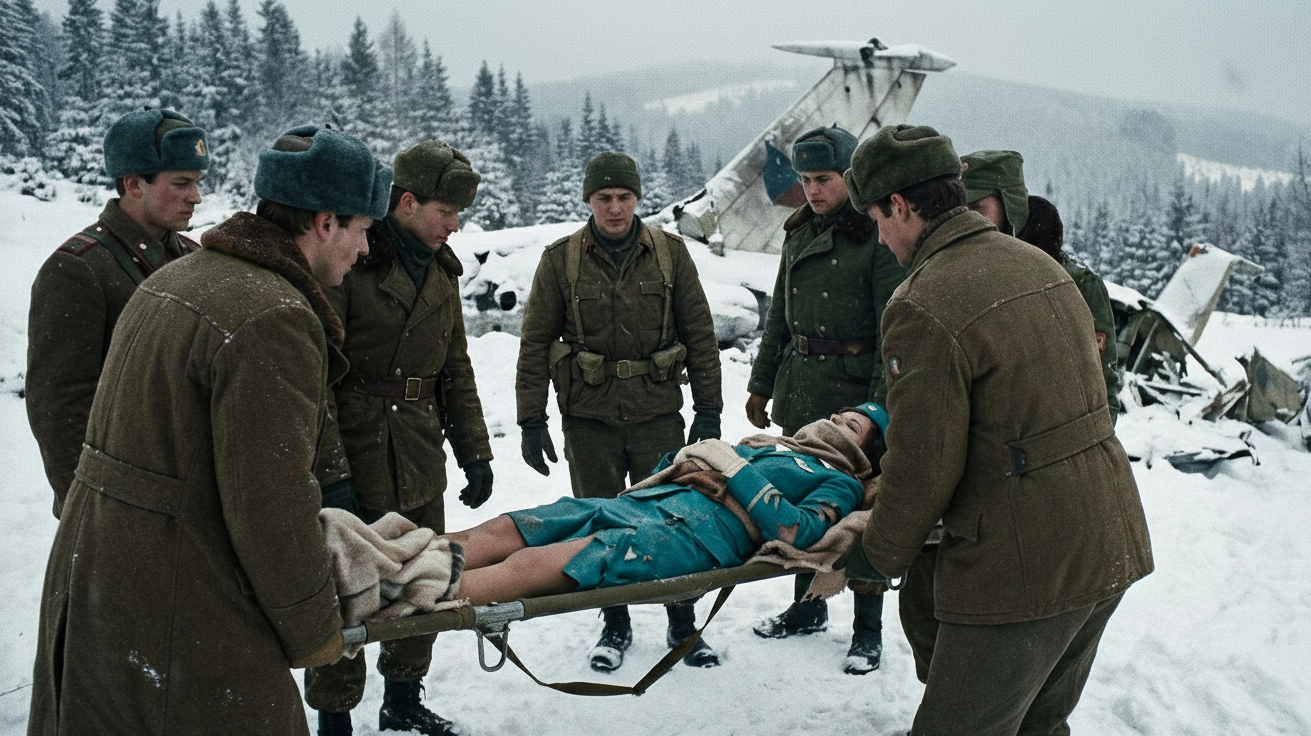
Instead, he saw a turquoise uniform covered in bl00d.
Vesna was half-hanging out of the wreckage. She was pale, broken, and barely conscious. But she was alive.
Bruno recognized the severity of her condition. He knew that if he moved her the wrong way, a broken rib might puncture her heart. He kept her still, kept her warm, and waited for help.
A Medical Miracle
When Vesna arrived at the hospital, the doctors couldn’t believe she had a pulse. Her injuries were consistent with a high-speed car crash, not a fall from the stratosphere.
-
Fractured skull
-
Three broken vertebrae (one crushed completely)
-
Broken legs
-
Broken ribs
-
Fractured pelvis
-
Cerebral hemorrhage
She was in a coma for days. She was paralyzed from the waist down.
The doctors had a theory about why she survived when everyone else was klld. Vesna had a history of low blood pressure. They believed that when the cabin depressurized, her heart didn’t explode because her blood pressure was already low. She passed out instantly, which kept her heart from bursting upon impact.
Her heart saved her by being “weak.”
The Darkness and The Light
Vesna woke up in a hospital room, confused. Her first request was for a cigarette.
She had no memory of the crash. The last thing she remembered was greeting passengers in Denmark. When they told her she had fallen 33,000 feet, she fainted.
The recovery was grueling. She underwent multiple surgeries to repair her shattered spine. She had to learn to walk again. But her spirit remained unbroken.
“I am like a cat,” she later told the New York Times. “I have had nine lives.”
Against all odds, the paralysis was temporary. Vesna walked out of that hospital on her own two feet.
The Survivor’s Guilt
The world hailed her as a hero. She was entered into the Guinness Book of World Records for “Highest Fall Survived Without a Parachute.” Paul McCartney presented her with the award. She became a national celebrity in Yugoslavia.
But the fame came with a heavy price.
Vesna was the sole survivor. 27 people—her friends, her colleagues, the passengers she had served coffee to—were dd. She felt a profound “survivor’s guilt.” Why her? Why was she the only one spared?
She never regained her memory of the accident, which doctors said was a blessing. She didn’t have to relive the terror of the fall in her nightmares.
The Mystery Remains
For decades, the official story stood: A briefcase b0mb planted by Ustaše nationalists destroyed the plane.
In later years, conspiracy theories emerged. Some claimed the plane was actually sht down by the Czechoslovak Air Force by mistake, and that the “33,000 feet” story was a fabrication to cover up the military error. They claimed the plane fell from a much lower altitude.
Vesna dismissed these claims. So did the black box data. The flight recorders showed the plane was indeed at cruising altitude when it disintegrated.
Whether it was 33,000 feet or 3,000 feet, the fact remains: She fell from the sky, and she lived.
A Legacy of Resilience
Vesna Vulović died in her apartment in Belgrade in 2016. She was 66 years old.
She didn’t die in a plane crash. She didn’t die from a bomb. She died peacefully, decades after the universe tried to delete her.
Her story remains one of the most baffling anomalies in human history. It is a reminder that the line between life and dth is thinner than the air at 33,000 feet.
Sometimes, it’s not about how strong you are. Sometimes, it’s just not your time to go.
Vesna’s life teaches us one final lesson: Even when your world falls apart, even when you hit the ground, you can still get back up.
Why This Story Still Haunts Us
We rely on the laws of physics to make sense of the world. When someone breaks them, it terrifies us. Vesna didn’t just survive a crash; she survived gravity itself.